
Tech Pack Clothing Manufacturing: Why the Bulk Order Doesn’t Match the Sample
The sample arrives, it fits, it feels right, the buyer approves it. Six weeks later the cartons land and something is off: the collar sits flatter, the fabric reads thinner, the stitching is looser. The supplier insists it is the same garment. Technically, it is the same style number.
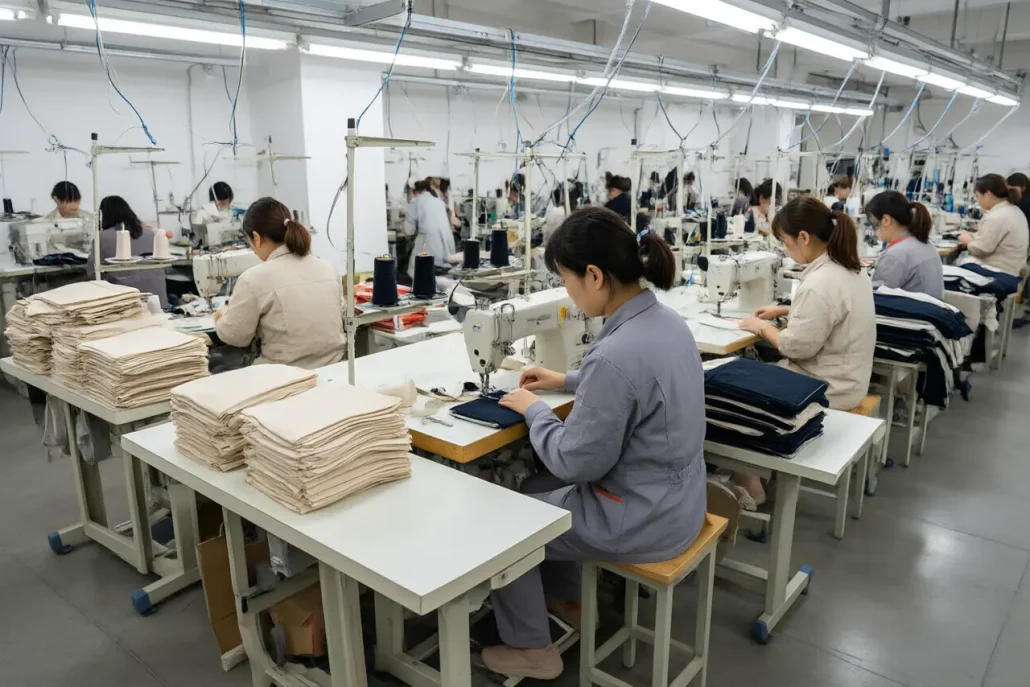
This is the most common disappointment in private label, and it almost never comes from bad faith. It comes from a gap between two rooms: the sample room where one technician makes one piece slowly, and the production floor where a line makes two thousand pieces against a target.
Who Made Your Sample Matters
Sample rooms are staffed by the most experienced people in the factory. They cut one piece, adjust the pattern by hand, press it properly, and inspect every seam. The result is often better than the specification, which makes it a poor reference for what the line can repeat.
Production runs on an industrial pattern, a different set of operators, and a rate per hour. Machines are set for speed, not for the one-off. If the spec does not describe what is essential versus what was craftsmanship, the line will legitimately choose speed.
What a Tech Pack Has to Carry
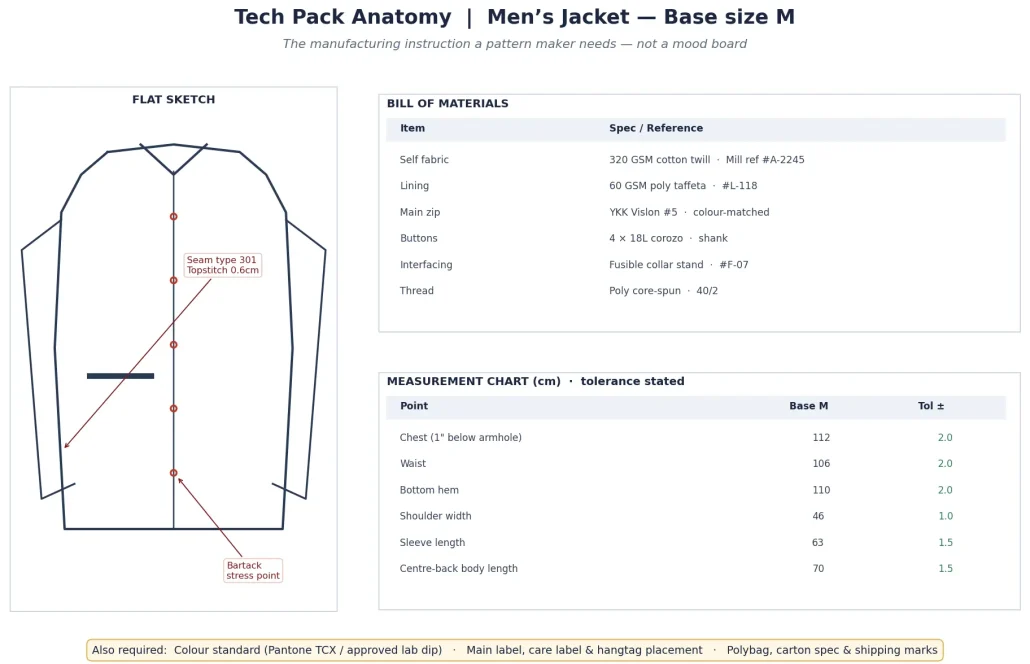
A tech pack is not a mood board. It is a manufacturing instruction, and it has to be complete enough that a pattern maker who has never spoken to you can cut the right garment.
- Flat sketch with callouts on every construction detail: seam type, topstitch width, stitch density, bartack positions.
- Bill of materials with fabric composition, weight in GSM, supplier or reference, and every trim, button, zip, thread and interlining.
- Measurement chart in centimetres with a stated tolerance per point, and the base size identified.
- Colour standard by Pantone TCX or a physical swatch, plus whether the lab dip was approved.
- Label and packing instructions: main label, care label, hangtag placement, polybag, carton configuration and marks.
Where the Information Breaks
Most of the loss happens before the factory starts cutting. A photo on a messaging app with the note “make it like this” carries no measurement, no tolerance and no fabric weight. A change agreed verbally at a meeting reaches the pattern room as a rumour, or reaches it late.
A second, quieter break happens between two samples: the one the buyer approved and the one the factory uses as its internal reference. If those are not the same physical garment, the bulk will follow whichever one the cutting room trusts.
Closing the Gap
Sign the tech pack, do not just read it. Every page should carry the buyer’s approval and the date, so a later argument is about a document rather than a memory. Seal one sample and keep it in the factory, labelled with the approval date.
Hold a pre-production meeting before cutting, with the pattern maker, the line supervisor and the QC lead in the same room, walking through the top five risk points. Then check the first output, not the last: the first fifty pieces tell you whether the line understood the spec.
FAQ
Do I need a tech pack for a simple T-shirt?
A lighter one, but yes. Even a basic tee needs fabric weight, composition, measurement points, stitch type and label placement. Without those, “the same as last time” becomes the specification, and last time drifts.
Who should write the tech pack, me or the factory?
The buyer owns the requirement; the factory can help translate it into manufacturing language. If the factory writes the whole spec, you have outsourced the definition of your product.
Why does the sample feel better than the bulk?
Because it was made by a sample technician at a slow pace with hand adjustments. Bulk follows the industrial pattern and the line rate. The fix is specifying what is essential, not asking the line to work like a sample room.
How many samples should be approved?
One approved fit sample, one sealed reference kept at the factory, and one pre-production sample from the actual bulk fabric. Approving a sample made in a different fabric is the most common source of colour and hand-feel complaints.
Contact ZSO today to request a quote, discuss your tech pack, or learn more about our OEM capabilities. Let us turn your designs into reality.