
FOB vs EXW: The Clothing Quote That Looks Cheaper
Clothing Sourcing: Why Is My EXW Quotation Cheaper On Paper But Higher In Real Landed Cost?
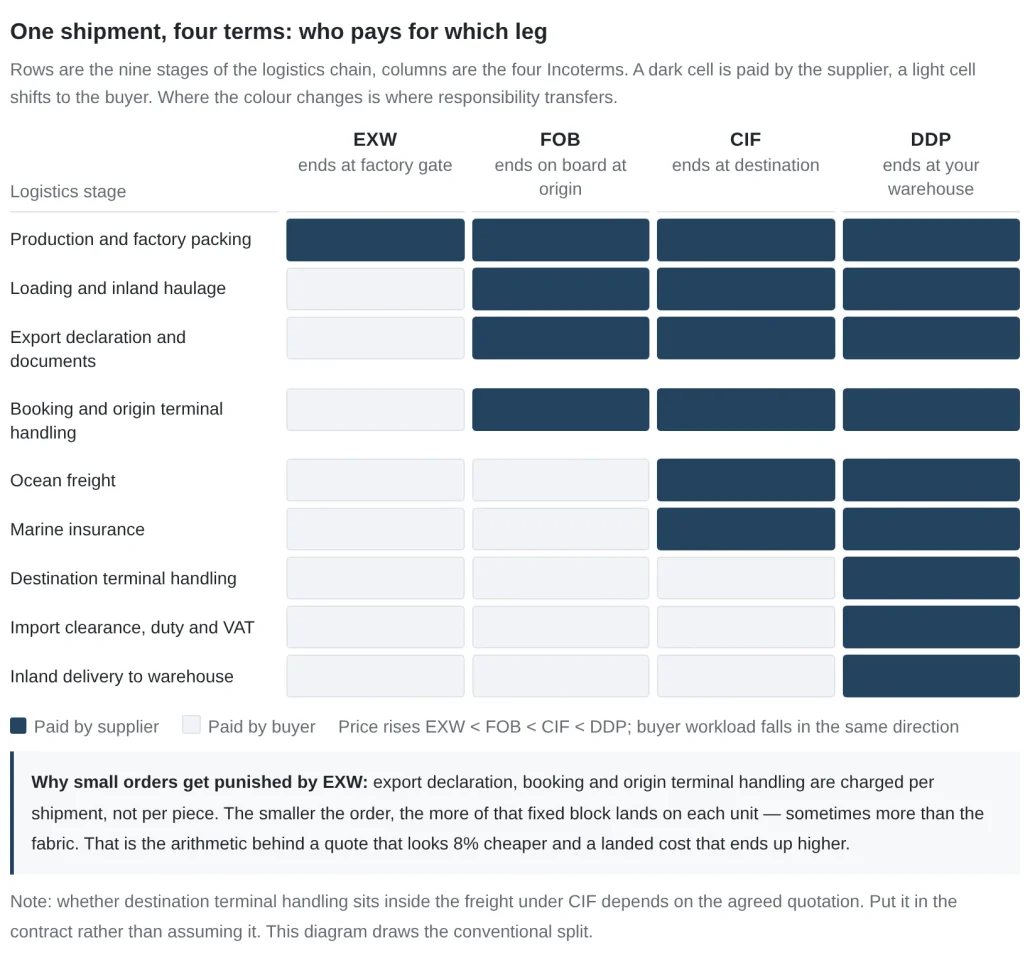
Your EXW unit price may look 8% lower, yet end up costing you more overall. EXW and FOB split logistics risks differently. Under EXW, inland haulage, export clearance and origin port fees land on you. For small orders, these fixed overheads can blow up your per-unit landed cost. Never compare face-value prices only — always calculate full landed cost per unit.
Quick Incoterm Breakdown
| Incoterm | Supplier responsibility ends | Buyer covers |
| EXW | Goods packed at factory premises; supplier obligation stops at the factory gate. | Loading, inland trucking, export formalities and origin port handling. |
| FOB | Goods delivered to origin port and export cleared; risk transfers on board vessel. | Ocean freight and all destination-side charges. |
| CIF | FOB plus ocean freight and marine insurance to destination port. | Destination clearance, duty, import VAT and last-mile delivery. |
| DDP | Door-to-door including duty; least workload for buyer, highest quoted price. | Buyer only receives the goods. |
Note: On small trial orders, fixed logistics costs can even exceed fabric costs. Missing documents may trigger expensive storage and demurrage fees.
How To Compare Quotes Correctly
Landed cost per unit = product cost + allocated freight and insurance + duty + clearance fees + final warehouse delivery
Check the following before accepting any quote:
- Confirm the Incoterm and where supplier liability ends, in writing;
- Ask for an itemized cost breakdown rather than a single unit price;
- Clarify who pays export declaration, origin terminal handling and document fees;
- Align packing, label and shipping-mark standards;
- Note what changes the price: quantity, colour count, fabric, lead time;
- Source freight separately to spot the supplier’s margin.
Hidden Pitfall Of Low-Ball Quotes
Many cheap-looking quotes omit inspection, carton upgrade or peak-season surcharges.
Rule of thumb: A transparent quote with fewer unknowns beats the lowest-number quote. Unclear pricing is only your negotiation starting point.
Quick FAQ
FOB or EXW for small importers?
Neither is universally better. EXW gives you freight control yet penalises small shipments with high fixed fees. FOB is simpler and often cheaper for small-volume sourcing.
Why higher total cost under EXW?
Removed logistics costs do not disappear; they shift to you. Small orders amplify per-unit overheads.
Request CIF and DDP too?
Yes. Compare FOB, CIF and DDP side by side to uncover supplier markup and underlying assumptions.
Key documents for FOB shipment?
Commercial invoice, packing list, certificate of origin and agreed compliance test reports. Missing paperwork is the top cause of port hold-ups.
Closing
Apparel sourcing success relies on landed-cost analysis, not superficial unit pricing.
Further reading: Labels, Certificates & Customs Documentation | Minimum MOQ & Trial-order Thresholds
ZSO Blog Invitation: Share this article with your suppliers during inquiry to align quoting rules and prevent cost disputes. Reach out to the ZSO team if you need help with quotation analysis and sourcing cost modelling.